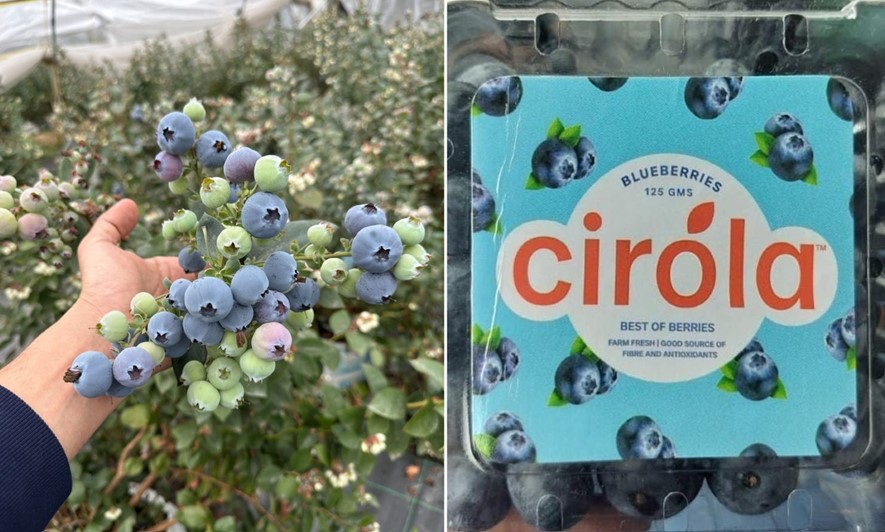


Article courtesy: Freshplaza
Blueberries are harvested from December to July. Raspberries available through the year. Indian-grown berries arriving on retail shelves under their own consumer brand.
That is a sharp change from 2021, when Konnect Agro entered a market still dominated by imported blueberries, seasonal strawberries and almost no domestically available raspberries.
Four years on, the category is beginning to look less like a luxury import shelf and more like a developing Indian food segment. Premium supermarkets and quick-commerce platforms have made berries easier to find, while urban shoppers are increasingly buying them for breakfast bowls, snacking and their health appeal.
Saurabh Vinayak of Konnect Agro Pvt. Ltd. says blueberries were considered a niche product when the company entered the market. Since then, demand has risen alongside middle-class consumption, growing health awareness and the spread of premium retail and instant-delivery services.
Konnect Agro grows blueberries, raspberries and strawberries under the CIROLA brand. Blueberries form the largest part of its portfolio.
The company uses Sekoya Pop from Fall Creek, along with the Demba and Dana varieties from Fruit Vision. The combination allows it to begin harvesting earlier and continue supplying fruit over a longer period.
“Sekoya Pop offers us a market-leading variety known for its high quality and yield while Fruit Vision offers early, high-yielding genetics, which gives us an extended harvest window,” says Saurabh Vinayak.
The harvest calendar is one of the company’s main advantages. Blueberries are produced from December to July, while raspberries and strawberries are harvested year-round. This gives CIROLA a more regular presence in stores and reduces some of the seasonality traditionally associated with berries in India.
Local production also shortens the distance between the farm and the shopper.
Imported berries travel through a longer supply chain, which can affect freshness and increase handling costs. Indian-grown fruit can reach the market faster, although domestic production is still at an early stage.
The bigger challenge is finding the right place and the right plant.
India’s climate varies widely, and berry varieties do not perform uniformly across regions. Growers are still conducting trials to identify suitable genetics and locations. Some mid- and high-chill varieties can be cultivated in open fields at higher altitudes, but commercial low-chill berries are largely grown inside polyhouses, tunnels and net houses.
That protection is necessary because berries respond quickly to changes in heat, humidity and rainfall. It also makes the business expensive.
Protected structures, substrate farming and specialised cultivation systems require substantial investment. Proprietary genetics are not always easy to access, and there is a shortage of workers trained in advanced berry cultivation.
Land adds another difficulty. Some regions suitable for berry production have limited availability of large, consolidated plots, making expansion slower and harder.
The risks continue after harvest.
Berries are fragile and highly perishable. India’s refrigerated road transport has improved, but last-mile movement still needs attention. Poor handling near the end of the supply chain can damage fruit quality before it reaches consumers. This is why branding is beginning to matter as much as cultivation.
CIROLA is being positioned around freshness, consistency and uniform quality. The idea is to make berries feel dependable rather than occasional, and premium without appearing inaccessible.
That shift may gather pace as more growers enter the category. Greater domestic output could gradually lower prices and make berries available to a wider group of consumers.
Saurabh expects quick commerce and modern retail to push demand beyond India’s largest cities. Continued growth will depend on stronger breeder partnerships, specialised nurseries, local research, trained farm workers and better cold-chain systems.
The future of India’s berry market will rest on whether growers can solve those production gaps while building trust in locally grown fruit. For now, the category is moving steadily from imported novelty to a more familiar place on the Indian shelf.